In Depth Review: Desert Flower — Waris Dirie – One day you are worth exactly five camels in the Somali desert; the next, you are the face of Revlon on a London billboard.
1. Introduction: The Book’s Impact on Its Genre
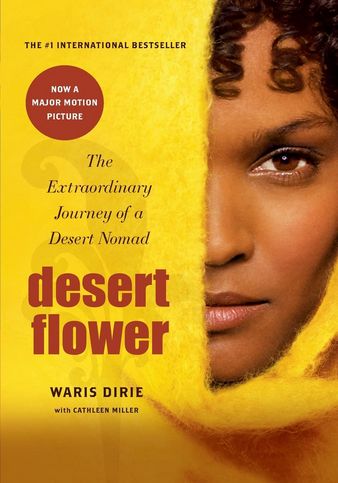
Before 1998, the “supermodel memoir” was a predictable literary genre. It usually consisted of glamorous anecdotes, mild industry gossip, and platitudes about inner beauty. Then came Waris Dirie’s *Desert Flower*. Exploding onto the literary scene, this autobiography completely shattered the boundaries of its genre. It was not merely the story of a fashion icon; it was a profound socio-cultural document, a harrowing survival thriller, and a fierce human rights manifesto. By merging the anthropological detail of a National Geographic study with the pacing of a cinematic epic, Dirie achieved something unprecedented. She brought the deeply taboo subject of Female Genital Mutilation (FGM) out of the shadows and onto the global stage. As a literary critic, I marvel at its narrative arc; as a science communicator, I recognize it as a masterclass in using personal biology and sociology to educate the masses. *Desert Flower* proved definitively that the most gripping stories ever told do not require a novelist’s imagination—they simply require the truth.
2. Premise Analysis: What Is the Author Trying to Prove?
At its core, *Desert Flower* is a study in **dichotomy and bodily autonomy**. Waris Dirie’s central premise is that human resilience can bridge the most extreme socio-economic and cultural gaps on planet Earth. Through her staggering transition from a nomadic Somali childhood to the zenith of European high fashion, Dirie seeks to prove two critical points. First, she illustrates the sheer, arbitrary luck of geographic birth. She meticulously contrasts the survival-driven, water-scarce reality of the desert with the superficial, excess-driven world of Western fashion to show how both environments demand different, yet equally intense, forms of adaptation. Second, and most urgently, Dirie attempts to strip away the “cultural relativism” that often shields brutal practices from criticism. She uses her own body as evidence to prove that FGM is not a sacred tradition to be respected, but a catastrophic medical and psychological trauma to be eradicated. She proves that a woman can love her heritage while simultaneously going to war against its darkest elements.
3. The 3 ‘Moments of Awe’: Realities Stranger Than Fiction
Moment #1 — The Five-Camel Price Tag and the Desert Escape
At just thirteen years old, Dirie’s father arranged for her to marry a sixty-year-old stranger. Her bride price? Five camels. In a fictional story, the heroine might be rescued. In reality, Waris rescued herself by fleeing alone into the unforgiving Somali desert. The “awe” in this sequence is viscerally terrifying. She navigates without a compass, survives blistering heat and dehydration, and at one point, literally locks eyes with a lion in the wilderness. The beast, perhaps sensing she had no flesh left to offer, spares her. It is an account of human endurance that rivals the most intense survivalist literature ever published.
Moment #2 — From the McDonald’s Floor to the Pirelli Calendar
The sheer statistical improbability of Dirie’s rise in London defies belief. After escaping Somalia, navigating bureaucratic nightmares, and working as an illiterate cleaner at a local McDonald’s, she was spotted by legendary fashion photographer Terence Donovan. To go from scrubbing grease off a fast-food floor—unable to speak fluent English—to gracing the cover of the exclusive Pirelli calendar and walking the runways of Milan and Paris, is the ultimate Cinderella story. Yet, it is entirely real. It highlights the bizarre, almost alien nature of the fashion industry, where a traumatized nomad can suddenly become the aesthetic ideal of the Western world.
Moment #3 — The Medical Confrontation of FGM
The most gripping and scientifically sobering moment occurs when Dirie navigates the Western medical system. As a child, she was subjected to infibulation (the most extreme form of FGM). When she finally seeks medical help in Europe, the shock of the doctors—who have never seen such anatomical alteration—mirrors the reader’s own. The bravery required for Dirie to undergo reconstructive surgery, and the sheer biological relief that follows, is deeply moving. It demystifies the medical reality of FGM, transforming it from a distant, abstract concept into a tangible, anatomical crisis that she courageously conquers.
4. Density Critique: Filler vs. Value-Add Does*Desert Flower* contain filler?
For a reader strictly looking for glamorous fashion industry gossip, the extensive early chapters about goat herding and nomadic survival might feel dense. However, from a critical and educational standpoint, the **Learning Ratio** of this book is exceptionally high. Every page adds immense value. Dirie operates as an accidental anthropologist, providing incredibly detailed accounts of nomadic survival mechanics: how to find water, the social hierarchy of the tribe, and the mechanics of navigating by the stars. The later chapters, dealing with her life in London, offer a brilliant sociological critique of the First World. She looks at Western concepts of waste, money, and time through the bewildered eyes of someone who knows what it means to truly starve. There is no padding here. The juxtaposition of the two worlds *is* the story. The narrative density ensures that you are constantly learning—about African geopolitics, immigration law, the biology of FGM, and the psychology of culture shock.
5. Applicable Lessons: From the Nomadic Sands to Daily Life
Lesson 1: Re-evaluating “Necessity” and Wealth.
Dirie’s early life teaches a profound lesson in resource management. When your daily existence is defined by the search for a sip of water, Western anxieties about status and material goods are exposed as absurd. The book forces readers to recalibrate their definition of a “bad day,” fostering deep, grounding gratitude.
Lesson 2: The Courage to Break the Cycle.
Dirie loved her mother and her family deeply, yet she had the intellectual and emotional fortitude to recognize that the traditions they enforced (like FGM and forced child marriage) were wrong. The lesson applied to daily life is that you can respect your roots without being bound by their toxic cycles. Breaking a generational trauma often requires walking alone into the unknown.
Lesson 3: Your Scars Can Be Your Platform.
Instead of hiding her traumatic past to fit into the flawless facade of the modeling world, Dirie weaponized her pain. She became a UN Special Ambassador. The takeaway is that our deepest wounds, when spoken aloud, often hold the power to save others
6. Final Verdict: Who Is This Book For, and Why Invest the Time?
*Desert Flower* is not merely an autobiography; it is an emotional and intellectual awakening. Who is it for?
**Sociology and Anthropology Enthusiasts:** Who want a firsthand account of the clash between ancient nomadic traditions and modern Western capitalism.
**Advocates and Humanitarians:** Who need to understand the human face behind the statistics of FGM and forced marriages. *
**Anyone Feeling Stuck:** Who needs a stark reminder of the indomitable power of the human will. The time investment to read this book (roughly 6 to 8 hours) will yield a permanent paradigm shift. You will close the final page with a heightened sense of empathy and a profound respect for the resilience of the female body and spirit. Waris Dirie proves that the most breathtaking narratives don’t come from the minds of fiction writers, but from the footprints of those who walked through hell and decided to build a ladder out of the ashes.