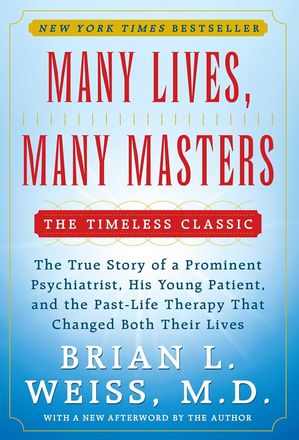
In Depth Review: Many Lives, Many Masters by Brian L. Weiss, M.D. Real Stories That Outstrip Fiction: A Psychiatrist’s Descent into the Soul
What if your crippling phobias are actually echoes of a life lived centuries ago?
In this provocative narrative, renowned psychiatrist Dr. Brian Weiss risks his medical reputation to document clinical sessions where a patient regresses into past lives. This transformative work explores the intersection of traditional therapy and reincarnation, revealing how “Master” spirits offer profound wisdom regarding our existence. You won’t waste a second; the “Learning Ratio” is exceptional as Weiss bridges the gap between clinical science and spirituality. It is an intellectually stimulating journey that reframes human suffering into a timeless curriculum for the soul’s evolution.
1. Introduction: The Book’s Impact on Its Genre
In 1988 *Many Lives, Many Masters* exploded onto the scene like a clinical grenade lobbed into the fortress of materialist psychiatry. Brian Weiss, a Yale- and Columbia-trained psychiatrist and head of psychiatry at Mount Sinai Medical Center, risked his career to publish transcripts from his sessions with a patient that suggested reincarnation was not myth, but verifiable therapeutic reality. This slim volume (just over 200 pages) birthed the modern past-life regression genre, blending rigorous medical case study with Eastern spirituality. Before Weiss, hypnosis was a fringe tool for smoking cessation or stage shows; after, it became a gateway for millions to explore the soul. The book sold over 2.5 million copies, spawned workshops, and influenced New Age therapy worldwide. More profoundly, it forced science communicators to grapple with the limits of empiricism: what if the most “fictional” stories—past lives, immortal souls—hold the key to healing real suffering? Weiss didn’t just impact self-help; he redrew the battle lines between mind and spirit.
2. Premise Analysis: What Is the Author Trying to Prove?
Weiss, a self-described “hard-nosed” scientist steeped in Freudian psychoanalysis and psychopharmacology, sets out to prove a radical thesis: the human soul is eternal, reincarnates across lifetimes to learn karmic lessons, and can be accessed via hypnosis to resolve modern traumas. Through his patient “Catherine” (pseudonym), a 27-year-old lab technician plagued by phobias, panic attacks, nightmares, and depression, Weiss documents how traditional talk therapy failed after 18 months. Hypnotic regression unexpectedly unearthed vivid past-life memories—spanning ancient Egypt to 20th-century Europe—that precisely matched her symptoms. Snake phobia? A past death by venomous bite. Fear of choking? Asphyxiation in a prior incarnation. But the proof escalates: Catherine channels disembodied “Masters”—enlightened souls between lives—who dispense universal wisdom on love, death as illusion, and soul evolution. Weiss, initially skeptical (attributing it to subconscious fantasy), becomes convinced when the Masters reveal private details about his life, including the recent death of his infant son and impending loss of his father. His proof? Therapeutic miracles: Catherine’s symptoms vanished, her life transformed. Weiss dares science to confront evidence that defies reductionism—the soul exists, reincarnates, and heals.
3. The 3 ‘Moments of Awe’: Realities Stranger Than Fiction
Moment #1: The Egyptian Slave Girl and the Scorpion’s Sting
Catherine, eyes closed in trance, describes her first regressed life: ancient Egypt, as “Aronda,” a young slave girl hauling water by the Nile. Exhausted, she rests near a rock; a scorpion stings her foot. She collapses, dying in agony as fellow slaves carry her away. This wasn’t vague metaphor—Catherine awoke screaming, her lifelong snake phobia (scorpions as arachnids evoke similar terror) eradicated overnight. A lab tech with no Egyptology knowledge recounts details (Nile mud, papyrus boats) too precise for confabulation. Fiction? A pulp novel. Real? A clinical cure.
Moment #2: The Masters Emerge from the Void
After dozens of regressions spanning 86 Earth lifetimes, Catherine transcends time: “I see a bright light… beings of light.” Suddenly, her voice deepens, cadence shifts—she channels the “Masters.” “We are here to teach you,” they intone. “Death does not exist. Only a change of form.” No New Age fluff; they outline karma (“hurting others rebounds”), reincarnation cycles, and soul groups. A swimwear model morphs into oracle, spouting quantum-like insights predating popular physics: “All is energy.” Weiss tapes it; transcripts chill with authenticity. This Sacks-esque transformation—ordinary woman as cosmic conduit—feels scripted for sci-fi, yet unfolded in a Manhattan office.
Moment #3: The Private Revelation That Shattered Weiss
Skeptical Weiss hides his personal grief: his 23-day-old son died of a heart defect; his father nears death. Midway through sessions, the Masters address him directly: “Your son is here with us, happy and healed. He came to teach you.” They name the infant (“Adam”—unpublished detail Catherine couldn’t know) and predict his father’s exact death date (fulfilled weeks later). No prior disclosure; Weiss confirms Catherine knew nothing of his family. A psychiatrist’s impenetrable psyche pierced by the “dead”—this personal verification elevates the book from anecdote to evidence.
4. Density Critique: Filler vs. Value At ~170 pages of core content (plus appendices)
Many Lives, Many Masters is a masterclass in narrative economy—no bloat, all thrust. Half is verbatim transcripts: raw, unpolished hypnosis logs that read like unscripted drama. The rest? Weiss’s interjections—clinical context, his evolving skepticism, philosophical asides—each advancing the premise. Critics decry repetition (multiple regressions follow a pattern), but this mirrors therapy’s iterative nature, building cumulative proof. Every “filler” anecdote? A phobia cured or Master quote layered with interpretation. Knowledge density rivals a neuroscience primer: hypnosis mechanics, Freud vs. Eastern thought, karma’s psychology. Entertainment? Riveting as a thriller—cliffhangers mid-session, Weiss’s “Eureka!” arcs. Versus fiction, its “realness” amplifies impact; no invented twists needed. **Learning Ratio: Phenomenal**—one page yields a past life, a cure, a metaphysical bombshell. Zero wasted words; every syllable serves the dare: Test this yourself.
5. Applicable Lessons: From Eternal Souls to Everyday Wisdom Weiss doesn’t peddle escapism; he arms readers with tools for now.
Lesson 1: Phobias as Echoes—Heal the Past to Free the Present.
Catherine’s terrors (water, snakes, flight) traced to deaths; resolved via recall. Daily application: Journal fears—do they feel “ancestral”? Hypnosis or meditation uncovers roots, dissolving anxiety without pills.
Lesson 2: Death’s Illusion Fosters Fearless Living.
Masters teach: “You return until lessons learned—love unconditionally, harm none.” This reframes loss (grief as temporary goodbye) and mortality (life as school). Apply: In conflicts, ask, “What karma am I accruing?” Cultivates compassion, reduces grudges.
Lesson 3: Open-Minded Science—Question Dogma.
Weiss’s arc—from atheist MD to soul-believer—urges skeptics: Evidence trumps ideology. Daily: Approach anomalies (déjà vu, synchronicities) as data, not dismissal. Fosters growth; as Masters say, “Only love is real.” Bonus: Aura-reading emerges in Catherine; Weiss validates via veridical perceptions. Lesson? Train intuition—it’s soul-sight.
6. Final Verdict: Who Is This Book For, and Why Invest the Time?
*Many Lives, Many Masters* is for the **rigorous seeker**: skeptics tired of scientism’s blind spots, therapists eyeing holistic tools, anyone haunted by “why me?” suffering. Not for closed minds—it demands vulnerability. Spiritual veterans? Rediscover clinical validation. The 4-6 hour read yields exponential ROI: shattered worldviews, phobia toolkit, death-proof peace. Real stories here eclipse fiction—no deus ex machina needed; the soul *is* the machine. Weiss, the elite psychiatrist who bet his reputation, proves: Truth stranger than novels awaits those daring to regress. In a post-materialist era (quantum entanglement nods to interconnected souls), this isn’t woo-woo—it’s frontier science. Read it; regress if compelled. Your “many masters” may whisper back.