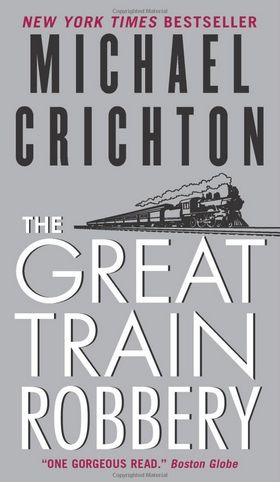
In Depth Review: The Great Train Robbery* by Michael Crichton – The Industrialization of Crime: A Victorian Autopsy
1. Introduction: The Book’s Impact on Its Genre
Before Michael Crichton became the father of the modern techno-thriller with *Jurassic Park*, he perfected a different kind of narrative architecture: the “historical reconstruction thriller.” Published in 1975, *The Great Train Robbery* was a departure from the sweeping, romanticized Victorian melodramas typical of the era. Instead, Crichton applied a clinical, journalistic, and almost forensic lens to the year 1855. The book’s impact was seismic. It pioneered the use of “pseudo-documentary” style in fiction, utilizing maps, court transcripts, and footnotes to create a sense of absolute reality. It stripped the Victorian era of its polite, Dickensian sentimentality and replaced it with the cold, hard steel of the Industrial Revolution. By treating a historical heist with the same technical precision one might use to describe a moon landing, Crichton transformed the historical novel into a vehicle for sociological and scientific inquiry.
2. Premise Analysis: What Is the Author Trying to Prove?
Crichton’s thesis is provocative: **The 1850s was the crucible of the modern world, and crime was its most innovative byproduct.** Through the lens of mastermind Edward Pierce and his audacious theft of £12,000 in gold bullion destined for the British Army in the Crimea, Crichton seeks to prove that as society became more organized, mechanical, and “secure,” the criminal element had to undergo a parallel evolution. He is analyzing the “Industrialization of Crime.” He challenges the myth of the Victorian era as a time of rigid morality. Instead, he portrays a society of staggering hypocrisy, where the glittering wealth of the Great Exhibition sat atop a foundation of child labor, open sewers, and a professionalized underworld. Pierce’s robbery is not just a crime; it is a “feat of engineering” that utilizes the very tools of the age—railways, telegraphs, and advanced metallurgy—to subvert the age itself.
3. The 3 ‘Moments of Awe’: Real History Surpassing Fiction
Moment #1 — The “Railway Spine” and the Terror of Speed
In the 1850s, the steam locomotive was the most terrifying machine ever built. Crichton describes a genuine medical phenomenon of the time: “Railway Spine.” Doctors and the public were legitimately terrified that traveling at thirty or forty miles per hour would cause the human brain to liquefy, or that the sheer vibration would cause internal organs to detach. This sounds like absurdist fiction, but it was a real scientific debate. This fear created a “psychological barrier” that the robbers had to overcome—to commit a crime on a moving train was seen as an act of suicidal madness.
Moment #2 — The “Snakesman” and the Physicality of Victorian Crime.
The book features a character known as a “Snakesman,” a criminal specifically chosen for his ability to squeeze through impossibly small gaps. In an era before motion sensors, security was purely physical. Crichton details the real-life training of these individuals, who could dislocate joints to enter chimneys or narrow vents. The scene where the snakesman must climb along the outside of a speeding train—without handholds and battered by gale-force winds—is pulse-pounding, yet Crichton reminds us that such physical feats were a staple of the 1850s “magsman” (professional thief) repertoire.
Moment #3 — The Four-Key Security Protocol
The gold was stored in two massive Chubb safes, each requiring two different keys held by four different officials. To copy these keys, the robbers had to track down the holders, stage elaborate distractions (including “ratting” matches and staged fights), and make wax impressions in seconds. The logistical complexity of this “four-factor authentication” in 1855 is staggering. It highlights that “high-complexity” security isn’t a digital invention; the Victorians were the original masters of encryption—they just used iron instead of code.
4. Density Critique: Filler vs. Value-Add
Crichton is famous for his “info-dumps,” and in *The Great Train Robbery*, he indulges in them frequently. He will pause the narrative to explain the slang of the Victorian “flash” language, the frequency of public executions, or the engineering specs of the South Eastern Railway. To a casual reader, this might feel like filler. To a student of history or a science communicator, it is pure gold. Every digression provides the “friction” necessary to make the heist feel earned. You cannot appreciate the difficulty of the crime without understanding the layout of London’s sewers or the specific chemical properties of the wax used for key impressions. The **Learning Ratio** here is exceptionally high. Crichton doesn’t just tell a story; he builds a world. By the end of the book, you haven’t just read a thriller; you’ve essentially completed a minor in Victorian Sociology. There is no “padding”—only immersion. Each fact is a load-bearing element of the plot.
5. Applicable Lessons: From the 1850s to the Present
Lesson 1: The Vulnerability of Systems.
Edward Pierce’s greatest weapon wasn’t a gun; it was his understanding of the *system*. He realized that security is only as strong as the human being holding the key. In modern terms, he was a “social engineer.” The lesson for today is that most “hacks” occur not through the hardware, but through the psychology of the people operating it.
Lesson 2: Technological “Edge Cases.”
The railway was designed for transport, not security. Pierce looked at the new technology and asked, “Where does this break?” Applying this to daily life involves looking at any new tool or system and identifying its “blind spots”—the places where its intended use creates unintended opportunities.
Lesson 3: The Persistence of Hypocrisy.
Victorian society ignored its “unmentionable” classes until they committed a crime that couldn’t be ignored. The lesson here is a social one: the parts of a system we choose to ignore or suppress are usually the parts that eventually cause the system to fail.
6. Final Verdict: Who Is This Book For?
*The Great Train Robbery* is for the **intellectual thrill-seeker**. It is for the reader who loves a heist but wants that heist to be grounded in the grime and gears of reality. It is a mandatory read for: *
**Heist Fans:** Who want to see the “Grandfather” of the modern high-tech robbery.
**History Buffs:** Who want a “street-level” view of the Industrial Revolution.
**Engineers and Systems Thinkers:** Who will appreciate the sheer logistical beauty of the crime’s execution.
Why is it worth your time? Because it proves that **real history has more “plot” than any thriller.** Crichton demonstrates that the 1850s were just as fast-paced, dangerous, and technologically disruptive as our own era. By the time you reach the final page, you’ll realize that Edward Pierce didn’t just rob a train; he robbed the future.