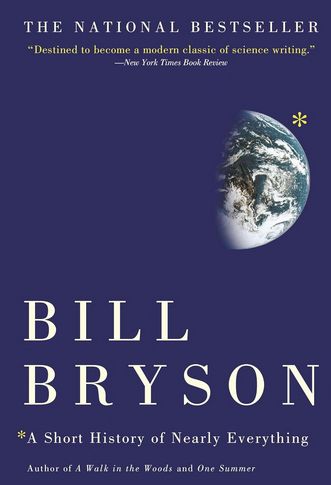
In-Depth review: A Short History of Nearly Everything — Bill Bryson – You are a cosmic accident. And this book will make you grateful for it
The Cosmic Lottery: Why Bill Bryson’s ‘Short History’ is the Ultimate Intellectual Thrill Ride
When Bill Bryson, a man previously best known for his curmudgeonly yet charming travelogues about hiking the Appalachians or navigating the eccentricities of Britain, announced he was writing a book about science, the academic world held its breath. The result, *A Short History of Nearly Everything*, did more than just summarize the Big Bang or the discovery of the cell; it recalibrated the entire genre of popular science. As a literary critic, I look for narrative tension; as a science communicator, I look for clarity. Bryson delivers both by treating the history of the universe not as a series of dry dates, but as a high-stakes drama of survival, characterized by staggering improbabilities and populated by a cast of geniuses who were, more often than not, complete lunatics.
1. Introduction: A Paradigm Shift in Popular Science
Before 2003, science writing was often bifurcated: you had the poetic, philosophical musings of Carl Sagan or the dense, rewarding, yet occasionally impenetrable theories of Stephen Hawking. Bryson carved out a third way. He approached the universe as an inquisitive amateur, a “science flâneur.” His impact on the genre cannot be overstated. He democratized complexity. By admitting his own initial ignorance, he invited the reader to learn alongside him. The book didn’t just sell millions of copies; it redefined the “knowledge-to-entertainment ratio,” proving that the laws of thermodynamics could be as gripping as a thriller if you have the right narrator.
2. Premise Analysis: The Improbability of Being
What is Bryson trying to prove? At its core, the book is an exploration of the sheer, terrifying luck required for you to be holding it. His premise is built on the concept of **Cosmic Improbability.** Bryson argues that the universe is not just “stranger than we imagine,” but actively indifferent—and occasionally hostile—to our existence. From the precise gravitational constant required to keep the universe from collapsing, to the specific atmospheric conditions that prevent us from being fried by cosmic rays, Bryson posits that we are the winners of a multi-billion-year lottery. He isn’t just teaching us history; he is teaching us gratitude. He wants to prove that being alive is an achievement, a “stunningly lucky break” in a universe that is mostly empty, cold, and dead. ###
3. The 3 ‘Moments of Awe’
To understand the “density” of this book, one must look at the facts that feel like fever dreams but are, in fact, cold reality.
The Atomic Recycling Program: Bryson reminds us that atoms are essentially immortal. When you die, your atoms will disassemble and go on to become part of a leaf, a neighbor, or a cloud. But the real “shiver” moment is his realization that we are all made of “recycled” parts. As he wittily notes, you likely have trillions of atoms within you that once belonged to Shakespeare, Genghis Khan, or any other historical figure you care to name. We are biological collages of the past.
The Yellowstone Time Bomb: Most of us view the Earth as solid and dependable. Bryson reframes it as a “thin crust” over a “cauldron of molten rock.” His description of the Yellowstone supervolcano—a geological feature that is “essentially a giant lid on a pressure cooker”—is terrifying. He notes that it erupts with the regularity of a heartbeat on a geological scale, and we are currently “due.” It is a humbling reminder that our entire civilization exists at the pleasure of tectonic plates.
The Loneliness of the Proton: Bryson’s description of the scale of the atom is a masterclass in science communication. He explains that if an atom were expanded to the size of a cathedral, the nucleus would be the size of a “fly,” but that fly would hold 99.9% of the atom’s mass. The rest is just vast, yawning nothingness. This means that even the “solid” world around us is, fundamentally, empty space.
4. Density Critique: All Killer, No Filler?
The central question for any reader considering this 500-page tome is: *Is it dense?* The answer is yes, but not in the way a textbook is. It is “knowledge-dense” but “narrative-light.” There is zero filler in this book. Bryson’s secret weapon is his curation. He skips the “boring” parts of history to focus on the eccentricities. We don’t just learn about the discovery of oxygen; we learn about the man who discovered it, Joseph Priestley, who was so unpopular he had to flee to America because a mob burned his house down. His prose is peppered with what I call “Brysonisms”—witty phrases that condense complex ideas into digestible bites. He describes the Earth’s atmosphere as “a thin layer of varnish on a globe,” and reminds us that “protons are remarkably long-lived; they have been around since the beginning of time and have yet to show the slightest sign of wanting to go anywhere.” This wit acts as a lubricant for the heavy data, making the density feel like a feast rather than a chore.
5. Applicable Lessons for Daily Life While it is a book about “everything,” the takeaways are deeply personal.
Existential Humility: After reading about the “Big Rip” or the precariousness of our orbit, you realize that your “big” problems—a missed promotion, a slow Wi-Fi connection—are cosmically insignificant.
The Value of Curiosity: Bryson demonstrates that “not knowing” is the first step toward genius. The lesson for the reader is to remain an amateur; to keep asking “Why?” even when the world expects you to have the answers. * **Environmental Stewardship:** By detailing how rare the conditions for life are, Bryson makes a subtle, powerful argument for conservation. We are on a “Goldilocks” planet; if we break it, there is nowhere else to go.
6. Final Verdict: Who is this Book For? ‘
A Short History of Nearly Everything’ is for the person who feels that the world has lost its magic. It is for the student who hated science in school because it was taught as a list of facts to memorize, rather than a detective story to solve. It is worth the time investment because it provides a “mental map” of reality. You will finish this book and never look at a rock, a tree, or your own hand the same way again. It is a dense, witty, and profoundly moving tribute to the fact that, against all odds, we are here. In a universe that is mostly nothing, Bill Bryson reminds us how spectacular it is to be *something*.
Veredict: Essential reading. It is the only “history” book that makes you feel younger and more curious with every chapter.