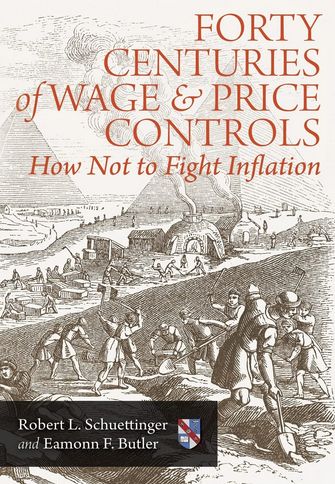
In Depth Review: Forty Centuries of Wage and Price Controls — Schuettinger & Butler – If history is a teacher, mankind has been a spectacularly failing student for four thousand years.
1. Introduction: The Book’s Impact on Its Genre
In the landscape of economic literature, there are textbooks that explain how things *should* work, and then there is *Forty Centuries of Wage and Price Controls: How Not to Fight Inflation*. Originally published in 1979 by Robert Schuettinger and Eamonn Butler, this book remains a seminal work in the “economic history” genre. Its impact lies in its sheer, relentless scope. While most economic treatises focus on a single era or a specific school of thought, this book functions as a chronological autopsy of a single, recurring policy failure. It transformed the way we view government intervention by providing what science communicators call “longitudinal data.” By stripping away the political rhetoric of forty different centuries, the authors revealed a scientific law of human behavior: you cannot legislate the value of a currency without triggering a catastrophe. It is the ultimate “I told you so” in the history of the dismal science, proving that while technology and cultures change, the laws of supply and demand are as immutable as gravity.
2. Premise Analysis: What Is the Author Trying to Prove?
The premise of Schuettinger and Butler is as daring as it is simple: **Governments throughout history have used price controls to hide the inflation they themselves created, and they have failed every single time.** The authors set out to prove that price controls are not merely ineffective; they are a “political placebo” that masks the internal bleeding of an economy. The book argues that inflation is almost always a monetary phenomenon—the result of a government printing or debasing money to pay for its debts. When the inevitable result (rising prices) occurs, politicians attempt to “command” prices to stay low through edicts, laws, and even the threat of death. The authors demonstrate that this intervention shifts the problem from “high prices” to “total unavailability.” By fixing prices below market value, the government destroys the incentive to produce, leading to shortages, black markets, and eventual societal decay. The book is a 4,000-year proof that you cannot cure a fever by breaking the thermometer.
3. The 3 ‘Moments of Awe’: Real History Surpassing Fiction
Moment #1 — The Code of Hammurabi’s Stagnation
In ancient Babylon (c. 1750 BC), the legendary King Hammurabi didn’t just give us the “eye for an eye” law; he gave us the first recorded comprehensive price control system. He set fixed wages for shepherds, artisans, and field laborers. The “awe” factor here is the immediate consequence: the Babylonian economy, which had been flourishing under a relatively free trade system, ground to a halt. The rigid wages meant that as conditions changed, labor couldn’t move to where it was needed most. It is staggering to realize that the very first civilization to record its laws also recorded the first man-made economic depression.
Moment #2 — Diocletian’s “Death Penalty” for Prices
The most dramatic failure in the book is the Roman Emperor Diocletian’s *Edict on Maximum Prices* in 301 AD. Rome was suffering from hyperinflation because the government had debased the denarius until it was essentially copper. Diocletian responded by fixing the prices of over 1,000 goods and services, with the penalty for “overcharging” being death. The result sounds like a dystopian novel: trade stopped because it was literally “deadly” to sell a loaf of bread for what it actually cost to produce. People fled the cities to escape the tax collectors and the price police, essentially triggering the beginning of the feudal system. The mightiest empire in history was brought to its knees not by barbarians, but by an edict that ignored basic math.
Moment #3 — The French Revolution’s “Law of the Maximum”
During the Reign of Terror, the French revolutionary government passed the “Law of the Maximum” to cap the price of grain. When farmers refused to sell at the artificial price, the government sent the military to seize the crops. This led to a feedback loop of violence: the more the government controlled prices, the more people starved; the more people starved, the more the government used the guillotine to punish “hoarders.” It is a chilling reminder that price controls are not just “economic policy”—they frequently evolve into state-sponsored violence.
4. Density Critique: Filler vs. Value-Add
Clocking in at under 200 pages, this book is a marvel of **informational density**. There is absolutely zero “filler.” The authors move through ancient Egypt, the Ming Dynasty, the American Revolution, and the Nixon era with a speed that would make a novelist dizzy. Every page adds value because it follows a rigorous pattern:
Step 1 The Government inflates the currency;
Step 2 Prices rise;
Step 3 The Government passes a law to stop prices from rising;
Step 4 Shortages and black markets occur
Step 5 The Law is eventually repealed or the society collapses.
By repeating this pattern across forty centuries, the book creates a “Learning Ratio” that is through the roof. You aren’t just learning facts; you are learning to recognize a biological-like response in the body politic. The book is an essential “knowledge bomb” for anyone who wants to understand why certain modern societies—from Venezuela to various populist movements in the West—continue to struggle with the same delusions.
5. Applicable Lessons: From Ancient History to Your Daily Life
Lesson 1: Recognize “The Symptom vs. The Cause.”
When you see a politician blaming “greedy corporations” or “speculators” for high prices, Schuettinger and Butler have taught you to look at the central bank instead. Prices are merely a reflection of the value of the money. Apply this to your life by understanding that if the money supply expands, your savings are being diluted, regardless of what the price tags say.
Lesson 2: The Inevitability of Black Markets.
The book proves that humans will always find a way to trade at “real” values, even under threat of death. This is an applicable lesson in organizational management: if you create rules that ignore reality, your “employees” (or citizens) will create a “shadow system” to get the work done. You cannot mandate away human incentives.
Lesson 3: The Danger of “Short-Termism.”
Price controls are always popular in the first week because they look like a “fix.” But the book teaches us to look at the “week after next”—where the shelves are empty. In daily life, this is a call to avoid “quick fixes” for complex problems. If a solution seems too simple (like just “ordering” things to be cheaper), it is likely a trap.
6. Final Verdict: Who Is This Book For?
*Forty Centuries of Wage and Price Controls* is a mandatory read for **every voter, every policy maker, and every student of history.** It is especially vital for the modern “science communicator” because it demonstrates how economic laws are as predictable as chemical reactions. Why is it worth your time? Because it provides you with a **historical immunity** against bad ideas. In an era where “price caps” and “rent controls” are once again being touted as compassionate solutions to inflation, this book serves as a necessary, intellectually stimulating cold shower. It is the story of 4,000 years of people trying to make 2+2=5, and the devastating consequences that followed. It is a brief, dense, and entertaining journey that will leave you significantly more economically literate than when you started.